Hackers Heat Freezers to 50 °C, Albert’s Parent Company Hit, and Rohlík Leaks Customer Data
Hackers Heat Freezers to 50 °C, Albert’s Parent Company Hit, and Rohlík Leaks Customer Data
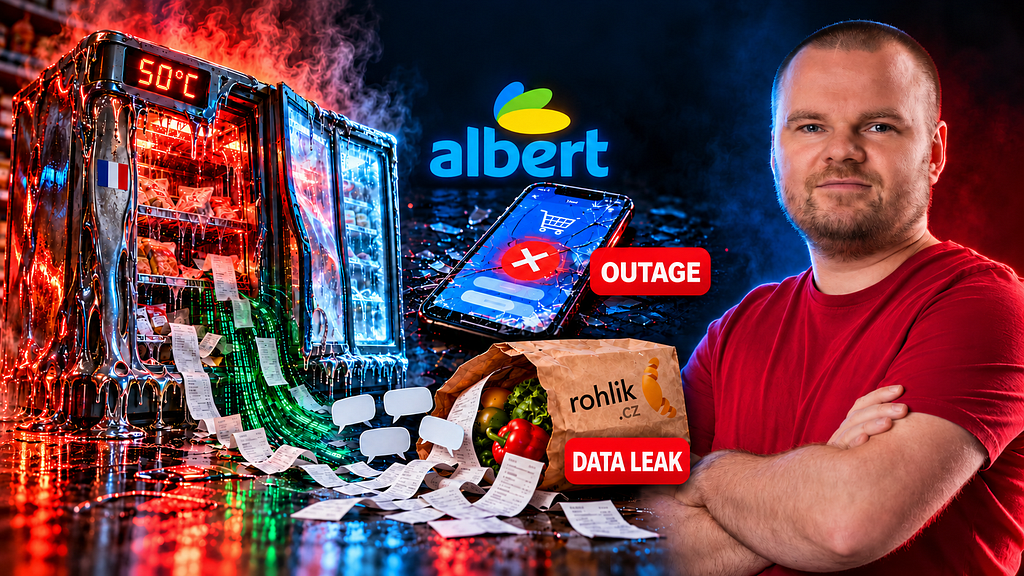
Imagine walking into a supermarket on a Sunday morning and finding the freezers at fifty degrees Celsius. That is exactly what happened last weekend in hundreds of French stores.And it wasn’t the only incident in the food sector that weekend. Ahold Delhaize, the group that owns Albert here in the Czech Republic, had to take part of its systems offline. And the Czech online grocer Rohlík sent its customers emails about a data leak from its customer support.
Hi, my name is Patrik Žák, and welcome to Security Sunday.
French Supermarkets
First, one important point. Based on what is publicly known today, these three cases are not connected. The Dutch National Cyber Security Centre explicitly states that it sees no reason to link Ahold to the attacks on refrigeration systems.
Let’s start with the most bizarre one. Over the weekend of 10–11 October, attackers took remote control of refrigeration control units in French supermarkets. These are controllers that manage all of a store’s refrigerated and freezer cabinets at once. They are made by the Danish company Danfoss, and service companies routinely manage them remotely.
Les Mousquetaires, the group that owns Intermarché, says the attackers switched the cabinets into defrost mode and the temperature climbed as high as fifty degrees. According to SecurityWeek, the units ran like this for about six hours, and all the stock had to be thrown away.
One detail of the whole incident caught my attention. According to Le Monde, the attackers extended the defrost cycles from one hour to as many as eight, which delayed the thaw alarms. That is not random damage to equipment. Someone knew how the system works and configured it so that staff would notice as late as possible.
French Finance Minister Roland Lescure told Parliament that roughly seven hundred of France’s approximately ten thousand supermarkets were affected.
Loss estimates vary. The head of Coopérative U says that in most of their affected stores the cold chain held, and only a minority had to throw goods away. The head of Les Mousquetaires, on the other hand, expects losses in the tens of millions of euros.
How the attackers got in has not been officially confirmed. For context, though, it is worth mentioning that Danfoss previously patched CVE-2025–41450, a vulnerability where administrator access could be obtained using a code that could be calculated from the current date.
The data from Censys is very interesting. On 11 October, it saw 1,825 internet-exposed Danfoss StoreView web panels in France alone. Three days later, only 537 were left. Patched and unpatched versions disappeared at the same rate, which means operators weren’t patching — they were simply taking the devices offline. Or rather, hiding what should never have been exposed to the internet in the first place.
Ahold
The second case is not about fridges, but about IT. On the morning of Monday, 12 October, Ahold Delhaize announced a security issue in its network and the precautionary shutdown of part of its systems.
The impact varied by brand. In the US, some websites went down and online ordering stopped. In the Netherlands, the loyalty card stopped working, electronic shelf labels in stores showed wrong prices, and some distribution centres came to a halt.
And here in the Czech Republic? The Můj Albert app was down, so customers couldn’t redeem coupons or see their points. The stores themselves, however, operated normally.
What do we know about the cause? Honestly, almost nothing. The company itself doesn’t use the word “attack”; it talks about a security incident. It has not published any details — no vulnerability, no indicators of compromise.
The company also says that so far it has no evidence that customer, employee or partner data was stolen.
So why keep an eye on it? This is the second time in two years that Ahold has gone through this. In November 2024, an attack hit its US business. The INC Ransom ransomware group later claimed responsibility, and the company confirmed that data had been stolen. If INC Ransom sounds familiar — yes, it’s the same group behind the recent attack on Partners, the Czech financial services group.
Rohlík
The third case is from home. On Sunday, 11 October, Rohlík.cz began emailing customers that an unauthorised person had gained access to an internal customer support tool and downloaded part of its data. According to a spokesperson, this happened during the previous week. The company blocked the access, fixed the flaw, and reported the incident to the Czech Office for Personal Data Protection (ÚOOÚ) and to NÚKIB, the national cybersecurity agency.
What leaked? Names, email addresses and the content of communication with customer support. Depending on how a customer contacted Rohlík, this may include emails, chats including uploaded files, or call transcripts along with the phone number — covering conversations with both human agents and the virtual assistant. The communication may also contain details customers wrote in themselves, such as a delivery address or an order number.
Also leaked was an overview of what customers had recently added to or removed from their shopping cart, as well as short notes the virtual assistant saved from conversations.
According to the company, login and payment systems were not affected. Rohlík has not yet said how many people are affected, how the attacker got in, or whether the group’s foreign brands are affected as well.
Why is this leak interesting even though it contains no passwords or card numbers? Because it is almost perfect material for social engineering. Rohlík itself warns that fraudsters may mention products you recently bought to make their messages look credible.
Imagine a phone call: “Hello, I’m calling from Rohlík about your complaint last week regarding the squashed strawberries. I’ll send you a link for the refund.” The attacker knows your name, your number, the content of your complaint and what was in your cart. Far more people will fall for a call like that than for a generic text about an undelivered parcel.
Rohlík is clear on this: it never asks for your password or card details.
And one last observation for companies. AI assistant notes are a new category of data that many organisations don’t account for in their data classification at all. Call transcripts and chatbot memory should be in your record of processing activities just like your CRM — including how long you retain them.
What They Have in Common
Three incidents, three different types, but a few things keep coming up.
The food sector is critical infrastructure that nobody talks about much — until you’re facing empty shelves or warm freezers. Both at Ahold Delhaize and in France, we saw how quickly a cyber problem turns into a physical one.
Third parties are another recurring theme. Refrigeration is managed by service companies; customer support runs on internal tools and AI assistants. Your attack surface doesn’t end at your own firewall.
And then there’s exposed OT. CERT-FR reminds us that exposing management interfaces to the internet goes against good practice.
If you run any kind of technology in your stores or sites, take an inventory of what’s visible from the internet — including devices that belong to your service provider. Management interfaces don’t belong directly on the internet; remote access should go through a VPN or a protected network, and IP filtering is only a stopgap.
A single weekend showed us refrigeration sabotage, an outage at a giant retail chain, and a data leak that can be used for very convincing scams. In all three cases we still don’t know who is behind them — and in Ahold’s case, we don’t even know exactly what happened.
If you want to know what an attacker can see of your company on the internet, or test how your people would handle personalised phishing, get in touch.
Subscribe so you don’t miss the next episode, and see you next Sunday.
Password “123456” Unlocked Denmark’s Civil Registration System
Denmark’s Central Person Register (CPR) has confirmed a serious security incident. On 5 October 2026, the CPR Office announced that unauthorised individuals had abused a Danish company’s legitimate lookup access to the register and obtained names, addresses, CPR numbers (the Danish equivalent of a national identification number) and other details on roughly 8.8 million registered persons.
According to documents obtained by the broadcaster TV 2, the lookups ran from 10 to 20 September. They amounted to more than 14 million automated queries, of which about 8.8 million returned a record. Datatilsynet, the Danish data protection authority, described the activity as very extensive automated searching aimed at finding valid CPR numbers. No alarm was triggered. The breach only came to light on the evening of 2 October, when CPR staff noticed an unusually high invoice — companies pay for every query.
The account belonged to Pays ApS, a small company from Odense that offers its customers address updates and validation of customer data against the CPR register. On 9 October, Pays confirmed to TV 2 that its access had been abused.
After examining the leaked data, the newspaper Politiken reported that at least three Pays accounts, including an administrator account, used the password “123456”.
Burger King Japan: Approximately 11.18 Million Member Records Leaked from App
BK Japan, which operates the Burger King chain in Japan, announced on 15 October 2026 that an unauthorised third party had gained access to the system that manages member data for its official app. According to the company’s official notice, the unauthorised access took place from 2 to 7 October, and the leak was confirmed on 13 October. Approximately 11.18 million member records were affected. This is the number of records, not necessarily the number of unique individuals.
The leaked data includes member ID, email address, registration type, prefecture, gender, date of birth, full name (in both kanji and katakana) and phone number. Flags indicating whether the member had used mobile ordering and whether their email address was verified also leaked. BK Japan states that it does not store payment card numbers, so they could not have been leaked.
MITRE ATT&CK v20: AI Agents, MFA Bypass via App Passwords, and Real-World Attacks on Water Utilities
MITRE released ATT&CK v20 on 13 October 2026. The headline change is nine new techniques and sub-techniques in the Enterprise domain, five of which describe how attackers target or abuse artificial intelligence systems.
Direct Prompt Injection (T1699) covers malicious instructions entered directly into a large language model (LLM) interface, while Indirect Prompt Injection (T1698) describes instructions hidden in content the model processes — for example on a web page, in an email or in source code. AI-Enabled Exfiltration (T1700) covers situations where an attacker induces a corporate AI agent to send data outside the organisation. AI Result Poisoning (T1608.007) involves manipulating web content to influence what AI search engines and assistants recommend. Impair Autonomous Defenses (T1685.007) maps attempts to disrupt the analysis of malware and suspicious activity performed by LLM-powered security tools.
Compromise Software Dependencies and Development Tools (T1195.001) also received a significant update and now includes configuration files for integrated development environments (IDEs) and AI coding agents.
Not all of the changes are about AI. Steal Application Specific Passwords (T1697) describes a stealthy way to bypass MFA.
The threat intelligence content draws on recent incidents. The new campaign C0064 documents an intrusion into Mexican government institutions between December 2025 and February 2026, in which human operators used Claude Code and OpenAI’s GPT-4.1 for reconnaissance, vulnerability exploitation, credential theft and data exfiltration. The attack also hit a municipal water utility. Campaign C0066 describes the July attacks on more than 30 water and wastewater treatment facilities in Minnesota. The attackers logged into internet-exposed programmable logic controllers (PLCs) using default passwords and reconfigured them so that operators lost access.
New groups include the ransomware group The Gentlemen and the espionage group NIMBUS MANTICORE, linked to Iran’s Islamic Revolutionary Guard Corps (IRGC); 13 tools from its arsenal were also added to the knowledge base. The Salt Typhoon and APT38 profiles were significantly updated as well.
In the ICS domain, the new technique Command and Scripting Interpreter (T1701) arrives with six sub-techniques (PowerShell, Windows Command Shell, Unix Shell, Visual Basic, Python and JavaScript), while the previous Command-Line Interface and Scripting techniques have been deprecated. There are also new sub-techniques for command and control (C2) over DNS and publish/subscribe protocols. The release adds 15 new detection strategies: six for Enterprise and nine for ICS.
In the Mobile domain, Deliver Malicious Application via Other Means (T1476) returns; it was last included in v11.